Home Staging vs House Staging, Is There a Difference?
The short answer is no. Home staging and house staging refer to the same process: preparing a residential property for sale by presenting it in the most visually and emotionally compelling way possible for potential buyers. No professional stager in the UK would treat a "home staging" brief differently from a "house staging" brief. The techniques, the objectives, and the outcomes are identical.
The longer answer is that the distinction in terminology is not entirely meaningless, it reflects something real about how different audiences approach the staging conversation, and understanding that difference helps estate agents create more effective content and advice for their vendors.
But there's a more significant shift underway in this conversation. Whether you call it home staging or house staging, the method that dominated the industry for two decades, physically preparing a property, sourcing furniture, arranging accessories, and having a professional photographer capture the result, is no longer the only option. AI virtual staging now delivers the same buyer psychology results digitally, at a fraction of the cost, and without any of the logistics. The staging principles are unchanged. The method has fundamentally shifted.
What Does "Home Staging" Actually Mean?
The Industry Standard Term
"Home staging" is the dominant term used by professional stagers, industry associations, and the majority of UK estate agents. It describes the process of preparing a residential property for sale by making it as visually and emotionally appealing as possible to the widest relevant pool of buyers.
The word "home" is deliberate. It carries emotional weight. A staged property should feel like a home someone would want to move into, warm, liveable, aspirational, not like a property someone is trying to sell. That emotional dimension is central to why staging works: buyers make property decisions emotionally and rationalise them logically afterwards. Home staging is designed to trigger the emotional response first.
Where the Term Comes From
"Home staging" originated in the United States in the 1970s and became mainstream in the UK during the property boom of the early 2000s. Its rise in the UK was driven by two parallel forces: the influence of property television programmes that showed viewers the before-and-after transformation possible with staging, and the shift of the buyer's first impression from a physical estate agency window to an online listing photograph.
Once Rightmove became the dominant property search platform, the listing photograph became the primary marketing asset for any UK property. Home staging, with its focus on how a property looks on camera, moved from an optional extra to a strategic necessity for agents serious about listing performance.
What Does "House Staging" Mean?
The More Literal Term
"House staging" describes the same process but uses a more transactional, literal framing. A "house" is a building. A "home" is a dwelling with emotional resonance. The distinction carries a subtle but real difference in how the audience approaches the subject.
"House staging" searches in the UK tend to come from sellers who are treating the process practically rather than emotionally, people thinking about the asset they're selling rather than the space they're leaving. It also appears more frequently in searches related to detached and semi-detached properties, where the word "house" is the natural descriptor, while "home" is used more broadly across property types including flats and apartments.
Estate agents writing content for vendor-facing audiences, and landlords thinking about investment assets rather than personal homes, are more likely to reach for "house staging" naturally. Neither term is incorrect, and in the UK property industry both are universally understood.
Why Both Terms Coexist
The coexistence of "home staging" and "house staging" is organic rather than deliberate. There is no industry body in the UK that has standardised staging terminology, and different practitioners, agents, and vendors have settled on whichever word they habitually use to describe a residential property. Both terms generate significant search volume. Both attract an audience genuinely interested in the staging conversation.
For estate agents creating content around staging, covering both terms is worth doing, not because the advice differs, but because the audiences who search for each term are overlapping but not identical.
The Staging Principles That Apply to Both
What Every Well-Staged Property Has in Common
Whether the property is described as a home, a house, a flat, or an investment asset, and whether the staging is described as home staging, house staging, or property staging, the principles that determine whether it presents well for sale are consistent.
Light is the first principle. Staged properties feel bright and open. Natural light is maximised, heavy curtains pulled back, artificial lighting supplemented where needed, dark accessories replaced with lighter alternatives. Photography responds dramatically to light, and listings that look bright generate significantly more engagement than listings that look dark, regardless of the actual light conditions in the property.
Space is the second principle. Staged rooms are arranged to feel as large as possible. Oversized furniture that crowds the room is removed or replaced. Pathways through rooms are kept clear. The camera should be able to see the full depth and width of the space without obstruction. Buyers reading listing photographs interpret visual spaciousness as actual spaciousness, even where the rooms are objectively similar in size to competing listings.
Neutrality is the third principle. Personal items, bold colour choices, and divisive design decisions are replaced with neutral, broadly appealing styling. The goal is not to make the property look bland, it's to make it look like it belongs to the buyer who's imagining living there, rather than to the seller who currently does. Buyers need to project themselves onto the space. Strong personal styling creates friction in that projection.
Purpose is the fourth principle. Every room should have an immediately obvious, appropriate function that buyers can read from a photograph. An unused room being stored in, a dining room being used as an office, a bedroom so cluttered that its function is unclear, all of these create confusion in the buyer's mental model of the property and reduce their confidence in the listing.
Condition is the fifth principle. Staging amplifies the underlying quality of a property. It cannot compensate for poor maintenance. The cosmetic baseline, paint condition, cleanliness, fixture and fitting quality, needs to be solid before any staging layer adds value.
How AI Virtual Staging Changes the Conversation for Both
The Traditional Model and Its Limitations
For most of the history of UK home staging, the process was physical and labour-intensive. A professional stager visited the property, assessed the space, and either guided the seller through changes or arranged for furniture and accessories to be sourced, delivered, placed, and photographed. The turnaround was measured in days. The costs were measured in hundreds or thousands of pounds.
This model worked well for high-value properties where the investment was proportionate to the sale price. For the vast middle of the UK property market, three-bed semi-detached houses in commuter towns, one- and two-bed flats in city centres, buy-to-let investments being refreshed between tenants, the cost-benefit calculation rarely favoured full physical staging. Most sellers either skipped staging entirely or attempted a DIY version with inconsistent results.
What AI Virtual Staging Does
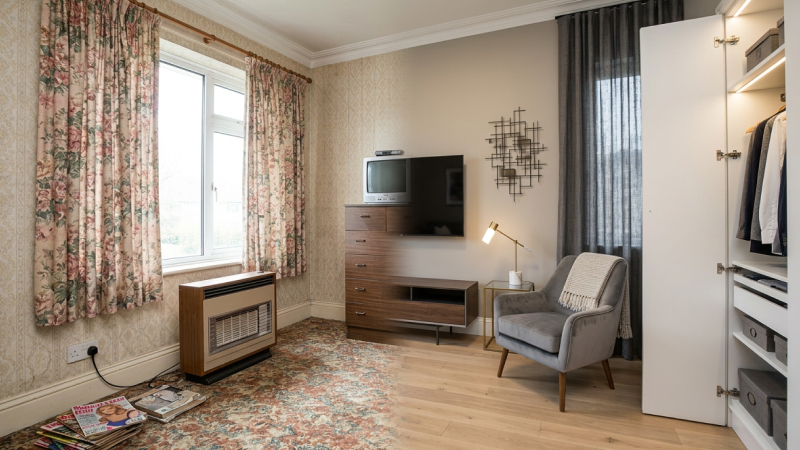
AI virtual staging applies the principles of home staging and house staging digitally. Rather than physically preparing the property and then photographing it, the photographer captures the space as it is, empty, occupied, or partially furnished, and the AI processes the image to produce a version showing the room fully furnished, styled, and presented to a professional staging standard.
The implications are practical and significant. A vacant property that would previously have required furniture hire can now be photographed empty and virtually staged in the same day. An occupied property where physical staging would be disruptive or impractical can have its key listing photographs enhanced digitally without touching the physical space. The three to four images that matter most for listing performance, living room, kitchen, master bedroom, can be professionally staged for under £20, with results delivered in minutes.
The principles being applied are the same ones that have always governed home staging and house staging: light, space, neutrality, purpose, condition. The difference is that AI now applies those principles to photography rather than to the physical space, which is exactly where those principles need to be working for today's property market.
Why the Method Matters More Than the Terminology
This is the practical conclusion of the home staging vs house staging conversation. The terminology is less important than the outcome: listing photographs that generate clicks, viewing requests, and competitive buyer interest.
Whether a seller describes what they want as home staging or house staging, the process that delivers the best result at the most accessible cost point in 2026 is a combination of sound physical preparation, declutter, clean, minor repairs, and AI virtual staging applied to the key listing photographs. That combination works equally well for a detached family home and for a one-bed flat. It works for a vacant investment property and for an occupied family home. The staging principles don't change by property type. Neither does the AI.
Practical Staging Guidance for Homes and Houses
Rooms That Matter Most
Regardless of whether a seller frames their staging need as "home staging" or "house staging," the rooms that drive buyer engagement in listing photography are consistent. The living room is the space buyers spend most time imagining themselves in. The kitchen is the room that most often determines whether a family property feels right. The master bedroom is the space that communicates lifestyle aspiration most directly. These three rooms should be prioritised in any staging brief.
Secondary bedrooms, bathrooms, and ancillary spaces should be clean, tidy, and purposeful, but don't require full styling attention if resources are limited. The hallway matters for viewings but has less impact on online listing performance.
Physical Preparation vs Digital Enhancement
The staging process involves two distinct stages that apply regardless of property type. Physical preparation, decluttering, cleaning, minor repairs, furniture arrangement, determines how the property feels when buyers visit. It cannot be replaced by AI virtual staging, and it shouldn't be. Buyers who visit after clicking on a virtually staged listing photograph need the physical property to live up to the promise of the image. That requires sound preparation of the actual space.
Digital enhancement, AI virtual staging applied to listing photographs, determines how the property looks when buyers first encounter it online. This is the stage that drives click-through rates, viewing requests, and initial buyer interest. It's where most listing photography currently underperforms, and it's where AI virtual staging has the most immediate impact.
The combination of both, physical preparation for viewings, AI virtual staging for listing photography, is the approach that delivers the strongest result across the full buyer journey.
FAQ
Are home staging and house staging the same service?
Yes. Both terms describe the same process, preparing a residential property for sale through decluttering, depersonalising, styling, furniture arrangement, and presentation techniques designed to improve listing photography and buyer engagement during viewings. No professional stager or estate agent distinguishes between them in practice.
Which term do UK estate agents use?
Most UK estate agents and professional stagers default to "home staging." "House staging" appears more frequently in organic searches from private sellers and in content aimed at detached and semi-detached property owners. Both are widely understood across the industry.
Does the type of property affect what staging involves?
Property type affects the emphasis and scale of staging rather than the fundamental approach. A flat may require more attention to space-maximising furniture choices and maximising light in potentially compact rooms. A detached house may need more attention to kerb appeal and the management of multiple living areas. A vacant property needs AI virtual staging far more urgently than an occupied, well-maintained property that photographs naturally well. The underlying principles, light, space, neutrality, purpose, condition, remain consistent.
Does AI virtual staging work for both homes and houses?
Yes. AI virtual staging processes listing photographs of any residential property type, flat, terraced house, semi-detached, detached, and applies appropriate furniture, styling, and finishing to produce a professionally staged result. The AI identifies the room type, interprets the space, and places furniture and accessories that are proportionate, realistic, and appropriate to the property style.
Why do different estate agent websites use different staging terms?
Because there is no industry standard enforced across the UK property sector. Agents and staging companies use whatever terminology resonates with their specific audience. Some have found that "home staging" converts better for private sellers; others find "house staging" more effective for their typical client base. The service being described is the same in both cases.
Is home or house staging worth it for a smaller property?
Yes, and often more so than for larger properties. Smaller properties face a specific photography challenge: rooms that are already compact can look very small or very large depending on how they're staged and photographed. AI virtual staging in particular is well-suited to smaller properties because it allows rooms to be shown with appropriately scaled furniture that demonstrates realistic proportion, something that's harder to achieve with physical staging on a tight budget.
Conclusion
The home staging versus house staging debate resolves quickly: the terms are different, but the process is the same, and the buyer psychology behind both is identical. What a buyer feels when they click on a listing thumbnail, whether the property looks inviting, spacious, liveable, and worth their time, doesn't change based on whether the seller described the preparation as home staging or house staging.
What has changed in 2026 is the method available to achieve that result. AI virtual staging applies the same principles that have always made staging effective, light, space, neutrality, purpose, condition, directly to listing photography, without the physical logistics, the lead time, or the cost of traditional staging. It works equally well for a detached family home and for a one-bed flat. It works for vacant properties and occupied ones. The distinction between home and house becomes irrelevant the moment the focus shifts to what actually matters: listing photographs that generate clicks and viewings.
For sellers and estate agents looking to apply professional staging to their listing photography quickly and cost-effectively, VirtualStagingExpert delivers the results in minutes, for homes, houses, flats, and every other residential property type in between.